
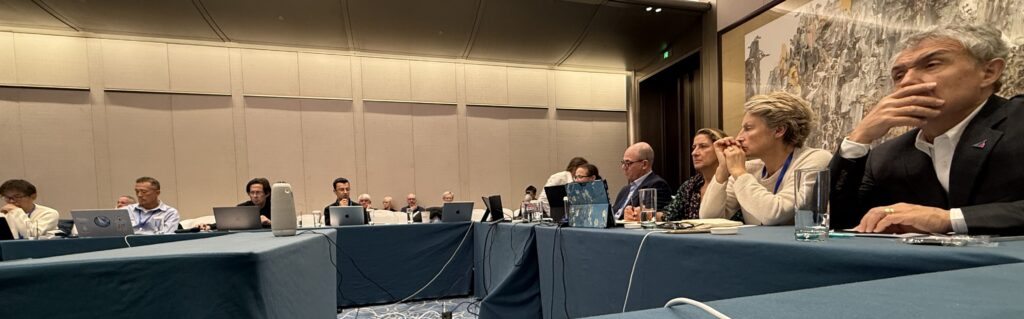
Present
Matt Allen, James Dadd, Lee Pilsung, Josep Pla(VP), Denise Caffari, Corinne Migraine(VP), Johan Tuvstedt, Glen Stanaway, Tatiana Almeida, Katrine Adloff, Yasutaka Funazawa, Katrina Ham
On-Line
Alan Massey, Bruno Finzi, Thomas Nilsson
Notes
Opening remarks from Matt, Corinne & Josep
Feedback was received on proposals regarding automated systems, in general from Organizing Authorities regarding the proposals set on the table.
Focus for coming year is governance structure. Special thanks
Executive update, This committee now falls under the department of sport, new manager Korai . Portal for proposals has been updated. Imoca class is progressing in terms of getting WS class status, Melges 32 is up for withdrawal.
Offshore Hub is up, urged committée to utilise the information channel. Mailing list has 245 subscribers.
Alan Massey reported on International Regulations. Autonomous Vessels caught some attention. IMO Code under development.
Glen Stanaway commented on the bullet 7b; Rating Systems governance review – The Rating systems were treated as classes due to the fact that there was no better place for them at the time when they arose to become endorsed by WS. Policies and regulations should be handled by a proper governance structure. Position from Equipment Committée is now the top governing body. Plan to come up with a plan is the status as of now. Blueprint of the process forward is to be created during the meeting.
Why this meeting matters
The Oceanic and Offshore Committee (OOC) is where World Sailing sets direction for offshore racing: the Offshore Special Regulations (OSR), rating systems, the offshore calendar and its own world championship. It meets on 19 November 2026 at the Annual Conference in Qingdao, China, the day after the Special Regulations Sub-Committee.
What’s on the table
| Topic | Why it matters | My take |
|---|---|---|
| CO-2026-021: who may change the OSR for an event | The only rule proposal for decision | |
| Offshore racing survey | How the sport will handle technology on board | |
| Rating systems governance review | Defines World Sailing’s relationship with ORC, IRC and SCHRS | |
| Stability (OSR 3.04) | Whether older boats can stay in Category 0 and 1 races | |
| Mixed Offshore World Championship | World Sailing’s own offshore title |
Who may change the OSR
CO-2026-021, from OOC Chair Matt Allen, concerns Regulation 22.3(b). Today the Board, after consulting the chairs of the OOC and the Special Regulations Sub-Committee, may approve OSR changes for a specific international event in exceptional circumstances. The proposal argues that classes, rating systems, national authorities and race organisers already adapt the OSR through class rules and race documents, and are best placed to judge safety for their own boats and waters.
It sits alongside OOC-2026-006, discussed by the Sub-Committee yesterday, which would set an order of precedence for those changes and stop anyone modifying OSR Sections 1, 2 and 6.
Technology and the offshore survey
Feedback to the below set out to be channeled to OOC Chair and WS Staff before the 27:th of November.
Survey to be approved by circular resolution, survey open for a month.
In October, World Sailing announced a global survey on the impact of new technology, and the draft questionnaire is now published. It covers fully crewed yachts only, and asks whether computers and automation should be allowed to control appendages, rigging and variable ballast. Class rules such as IMOCA, short-handed racing, powered winches and systems that only advise the crew are outside its scope.
The briefing to respondents is striking. It says the best autopilots already steer faster than top human helms, and that seven yachts at this year’s maxi championships carried LIDAR cameras. Top systems cost over €500,000. It expects steering, trimming and routing to be autonomous from start to finish by 2030. It then makes the case both ways: keep control with the crew to protect seamanship and contain costs, or let the technology run, as short-handed classes already do.
The 27 questions take 10–15 minutes. They cover the balance between people and technology today and in ten years, and whether each of seven technologies should be prohibited, restricted, permitted or encouraged. The last part asks whether rules should be global or set race by race. The committee decides on the draft tomorrow, and the results will be published.
The September minutes show where the thinking is heading. The committee recommended a new Oceanic and Offshore Code, including a ”Human Endeavour” rule (CO-2026-019). For fully crewed boats, organisers could allow powered systems but not computer-controlled ones. Short-handed and class racing keep their freedom.
Not everyone agrees. ORC’s annual report says it opposes the Code and its Human Endeavour provisions, and has joined RORC, the New York Yacht Club, CYCA, Storm Trysail Club, the Noordzee Club and others to find an alternative. Yet the same report backs limits on automated ”super-autopilots” in fully crewed fleets, so the gap may be narrower than it looks. The survey should help show where sailors themselves stand.
Rating systems
The IRC annual report shows 3,178 valid rated boats at the end of August 2026, down 5.9% on a year earlier. The RORC Rating Office notes that the Category 0 and 1 stability rules are getting harder to manage, as owners do not see why boats with past Atlantic crossings no longer qualify.
The ORC annual report tells the opposite story. By 1 November ORC had issued 15,687 certificates for 9,678 boats, 10% more certificates than a year earlier, through rating offices in 45 countries. The ORC Worlds in Sorrento drew 104 teams from 20 nations. ORC Multihull certificates rose 54%, and Weather Routing Scoring was used in about 50 races.
The committee will also look at how World Sailing governs rating systems. ORC, IRC and SCHRS are treated much like classes under Article 7 of the Constitution, with similar requirements for agreements, reporting and world championships. The revised paper, for information only, asks whether that category fits them, and whether International and Recognised rating systems should have different levels of recognition. It recommends a wider review together with the rating systems before any changes are proposed.
Stability
Richard Hintertoller reported on the stability database feasibility review. Group has been dissolved after the analysis was completed. 5000 designs are available in the database and polishing of data is underway.
The Stability Working Group’s paper is an open letter from Andy Claughton of the ORC. It argues that Category 0 and 1 boats should keep the inclining test rather than rely on the CE mark. It points to wide spread in stability within a single class, and an in-water measurement cost of €500–1,000. This is the opposite view to OOC-2026-003, which the Sub-Committee considered yesterday and which drew strong support from sailors planning races like the 2027 AZAB.
ORC’s annual report makes its position formal: its technical committee strongly opposes dropping inclining tests for Category 0 and 1, and will submit formal opposition to World Sailing.
The double-handed world championship
The 2026 Offshore Double Handed World Championship ran in Marseille. The committee heard a report and the plans for future editions; both papers are for committee members only.
In General the results were much improved in terms of satisfaction and wishes to return to future editions.
The 3 coming editions will be hosted by Cap Regatta and being Mixed Offshore World Championships, and dates are 11 October – 20 October. OA to be announced in NoR due to be out shortly.
The Board has awarded the 2027–2029 editions, to Cap Regatta, subject to contract.
The reports
- Safety Commission. Fewer incidents are being reported, which may reflect weaker reporting. Recurring themes are head injuries, keel and rudder failures, and recovering people from the water.
- International Regulations. Piracy rose 17% in 2025. 1,478 shipping containers were lost at sea. ISO is tightening harness standards. A new emissions control area in the north-east Atlantic starts on 1 September 2027.
- Speed records. New round-the-world records for Sodebo, The Famous Project CIC and Guirec Soudée on MACSF.
- Sailor Categorisation. 24 investigations into doubtful categorisations since November 2025, some ending in reclassification, cancellation or misconduct reports.
- Sustainability. New guidelines on avoiding collisions with whales and other marine megafauna, and an update to the Polar Yachting Guide.
What it means and what comes next
The two decisions tomorrow set process rather than rules: who may adapt the OSR, and how the technology survey is run. The big shifts are still ahead. The survey will shape any future technology rules, and the rating systems review could change how ORC and IRC sit within World Sailing.
The committee will also set its 2027 work plan, to be signed off by 1 December 2026.